Sunflower Semiotics 🌻

Updated: 4 hours ago

Sunflowers have long served as a signature of sorts for me, and you are likely to notice sunflowers scattered throughout messages, the website, my decor, and even the HIPAA-compliant telehealth meeting space’s waiting room (where, I assure you, they keep everything strictly confidential).
They are lovely aesthetically, for sure, yet beneath the bright petals and impressive height lie many layers of significance for me. What I share here reflects my way of connecting in and conceptualizing relationships, which could be significant to you if you are considering joining forces as partners in change.
An important anchor is to know that my relationship with the world is informed by animism, a way of perceiving all around us as being alive and relational, where everything from animals, to plants, rivers, grass, stones, weather systems, and beyond each carry an aliveness and agency of their own. An ethic long practiced across many cultures, animism places humans within an interdependent community of living beings, one kind of kin among many, all valuable and inextricably connected. (Aptly, this is derived from the Latin anima, translating roughly to breath, life, or spirit.)
Through that lens, I think of a sunflower as a relative and a teacher. I have deep appreciation for its multidimensional qualities, behavior, and lineage, making it a fixture of my life (and, by far, my most-reached-for emoji…!).
I am sure many of you arriving here can relate to the delight with which a neurodivergent brain lights up from going down a rabbit hole about a particular interest for you, and finding more and more alignment the deeper you dig, so consider this your invitation to grab a shovel and hop on in with me!
An Orientation to the Sunflower… Literally!
Young sunflowers practice heliotropism, orienting their faces toward the sun and following its path across the sky every day.
Fittingly, the sunflower's scientific name, Helianthus annuus, joins two Greek words: helios (sun) and anthos (flower). Following suit, girasol in Spanish brings together girar (to turn) and sol (sun). This makes sunflower something of a botanical aptronym, with these names describing core characteristics and behaviors beyond aesthetic resemblance.

To turn toward and follow the sun, in and of itself, is a lovely disposition to consider anchoring.
Having said that, it is important to avoid falling into toxically positive patterns that often serve as protective yet ultimately limit access to the full range of the human experience. In the dark of the night, sunflowers swing back around to face east, getting into position with a trust that the dawn they cannot yet see will emerge in due time.
In practice, this translates to finding an anchor in a realistic sense of hope while also holding space for the residue of harsher seasons, including the feelings and experiences shaping times before the source of the light was more deeply understood and the pattern of its rising proved consistent enough to confidently turn toward.
I commit to staying present to the conditions of each night I walk through with others, trusting what I have learned about navigating many trails and terrains by the stars, all the while holding the knowing that the light of morning will meet us once again.
At a high level, across cultures, sunflowers are believed to represent devotion, loyalty, warmth, adoration, vitality, and resilience, qualities I strive to embody and express, and also support others in integrating into their lives. The Victorians, who loved sending coded messages through bouquets, assigned the dwarf sunflower to adoration and the tall sunflower to haughtiness and arrogance. (I mean, they do have a lot of gall to be so tall; does that mean the secret to being adored is staying short and sweet?)
The (Dirt) Alchemist
Sunflowers are also gifted alchemists of the Earth.
Through a process called phytoremediation, a word derived from the Greek phyton (plant), and the Latin remedium (remedy), sunflowers draw contaminants up from damaged ground and water, holding within themselves that which would otherwise continue to harm the land and the beings who depend upon it.

After the Chernobyl disaster, sunflowers set afloat on rafts in a contaminated pond near the reactor drew radioactive elements from the water. Since then, they have been planted and studied around the world for their capacity to lift heavy metals from contaminated soil, including in Fukushima. Their roots reach deep into ground that has held poison, filtering what has been toxic through their own living systems and leaving the Earth more hospitable to life than they found it. And as the ground shifts, so does the potential for new growth to take root and thrive there. (Delightfully, in Ukraine's nuclear disarmament achievement, sunflowers became a symbol of a world free of nuclear weapons, and as the national flower also has gained significance as a symbol of resilience, warmth, and peace.)
Harsh conditions and harmful experiences have a way of settling into the soil of a life or a lineage. The path toward wholeness helps us learn to stay rooted, including when we find ourselves in places that once felt uninhabitable.
Carl Jung, borrowing from the alchemists before him, wrote of coniunctio, a sacred marriage of opposing forces whose joining makes integrated Wholeness possible. The sunflower embodies this as it draws elements the environment has absorbed up through its roots and stalk while drinking in the golden light it faithfully faces as it pours from above. Soil and sky, below and above, meet and are transformed all within this living body, which calls upon its wisdom to shape behaviors that radiate outward to support virtuous cycles rather than vicious ones.
I strive to bring this same rooted presence to the relationships I tend, trusting that what has been debilitating can, held in relationship over time, be transmuted into ground that is more vibrant and expansive and fertile, offering new possibilities for growth and future flourishing.
Still Standing After All This Time
More than four thousand years ago, people living along the Duck River (on Indigenous homelands taken through coerced treaties and forced removal that we now call Tennessee) were tending sunflowers. The Duck flows into the Tennessee River, known in the Yuchi language as K’alaw’ayuchi. (Notably, the Yuchi people refer to themselves as the Tsoyaha, or Children of the Sun, and my brain and heart love the resonance of the sun’s flower sharing a watershed with the sun’s children across the centuries.)
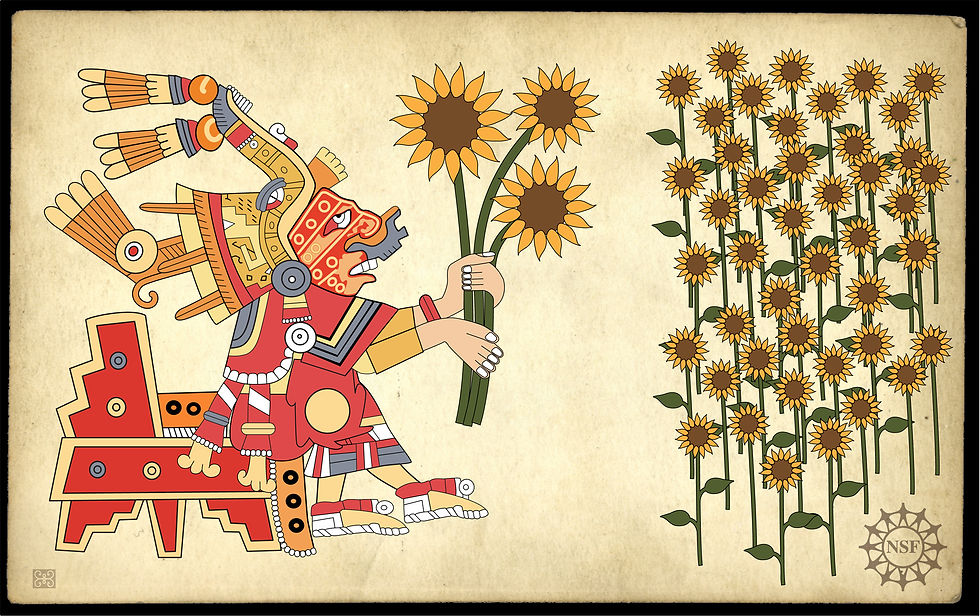
The seeds recovered and studied from this area are among the oldest domesticated sunflowers discovered anywhere in the world. Genetic research has since traced every cultivated sunflower on Earth back to a single domestication in eastern North America. This region stands among only about ten places in the ancient world where people independently and intentionally transformed wild plants into crops.
Indeed, thousands of years before corn traveled north, communities here were already cultivating the sunflower alongside squash and seed plants such as goosefoot and marsh elder. Of those early eastern crops, the sunflower is one of the very few still grown widely around the globe. The resiliency and enduring presence embedded in that legacy offer a striking model for all of us as we consider what it means to “do the work” as well.
Legendary Roots
Ovid opens his epic Metamorphoses with a promise:
in nova fert animus mutatas dicere formas corpora my spirit moves me to tell of forms changed into new bodies
(Not someone clocking so clearly how beings can become something else entirely when their system encounters too much, too fast, too soon all the way back in 8 CE while here in 2026 insurance companies stay trying to gaslight us into believing that the panacea for the adaptations we have all had to make in response to systemic, societal, and structural woes is to be found within no more than ten 53-minute sessions of straight CBT …!)
Tucked inside nearly 12,000 sprawling lines of Latin verse is a story told by King Minyas’ three daughters at their looms. In essence: rather than join the revels for Bacchus, god of wine and ecstatic abandon, the sisters stay home with their spindles and shuttles, weaving wool and trading tales over the loom as the rest of the city dances. (We love boundaried queens who choose to stay in to do a cozy activity together over a night of debaucherous extroversion, though regretfully Bacchus did turn them into bats by nightfall… a sobering reminder that we all have different capacities to tolerate people choosing to protect their energy!)
The tale one sister tells is a chain of disclosures in response to the emergence of big feelings, each one costing someone dearly. It starts when the Sun (Sol, whom the Greeks called Helios), looking down from his chariot, catches Venus in bed with Mars and tells her husband, Vulcan, what he witnessed. Humiliated and furious, Venus strikes back with a curse of her own, afflicting the all-seeing snitch that is the Sun with an uncontrollable, obsessive infatuation for a mortal princess named Leucothoe. The Sun is so consumed by his lust and limerence that he neglects his cosmic calling, lingering in the sky to gaze at her so that winter days stretched longer than intended, and eventually sneaking into Leucothoe’s chambers disguised as her mother while bending time to stay with her longer.

Into that chaos steps Clytie, a nymph the Sun had discarded. She could not bear to see him love someone else. Out of spite and jealousy, Clytie also tattles, exposing the Sun’s secret to Leucothoe’s father, King Orchamus, who buries his own daughter alive as a punishment for an assault to which she did not consent. (Notice the pattern of systems becoming overwhelmed such that harm keeps rolling downhill until it lands on the person with the least power... sound familiar?)
In his grief, the Sun pours nectar over Leucothoe’s grave, and a fragrant frankincense tree rises from it. Quelle surprise, Clytie’s act does not win the Sun’s love back and, in fact, actually hardens his heart toward her.
Remarkably, Ovid “holds both” in that he ascribes accountability to Clytie for the harm she set in motion while also recognizing the anguish that drove it with the line:
quamvis amor excusare dolorem indiciumque dolor poterat love could have excused her grief, and grief her telling
To understand this as an explanation (versus an excuse) emulates a stance I seek to embody working with partners in change to better understand the ways that our systems respond to protect us (even when the wholesale impact leads to more suffering or harm). Our first-line responses and reactions rarely arise out of nowhere; understanding the origin story of our thoughts, feelings, behaviors, body sensations, and other lived experiences is often an essential step toward healing and wholeness.
This serves as an important reminder that accountability does not require stripping anyone of their humanity, even as we see in practice in the story and in our lives, how projections and ego defenses can catalyze cascading, compounding pain for ourselves and/or others.
Case in point: in true Sad Girl™️ fashion, Clytie ends up sitting on the bare ground for nine days just watching the Sun from rise to set, eating nothing while drinking only dew and her own tears.
He never looks at her again, though, and she stays there gazing until her body roots into the Earth and her face turns into a flower.
Ovid provides another profound line about her fate:
vertitur ad Solem mutataque servat amorem she turns toward the Sun, and though changed, she keeps her love
This line speaks to something I often witness in grief and trauma work: loving does not simply cease when people part ways. Grief researchers call this concept continuing bonds, which speaks to the recognition that staying connected to who or what we have lost can be a healthy part of mourning. Denying the impacts and experiences of such connections is as much of a disservice to ourselves as is becoming untethered from the core of our Self.
What Ovid says can be read as a tribute or a warning, depending on the lens you see it through; the distinction lies in whether the love we carry keeps us stuck in place, or whether we integrate and metabolize it in ways that allow the connection to be significant while we live freely and expansively.
For the record, Ovid never actually saw what we know as a sunflower since they made their way to Europe much later when Spanish ships carried their seeds across the Atlantic in the 1500s. So, while it is not explicitly stated, the flower was most likely the heliotrope (Greek for “sun-turner”), a small purple plant native to the Mediterranean. Once sunflowers showed up in Europe, though, given the parallels, artists took liberties to depict Clytie as a common sunflower:
Clytie Transformed into a Sunflower, Charles de La Fosse
It is interesting that the sunflower inherited Clytie’s story, particularly since the living plant actually offers a wise path forward from what the myth conveys. Young sunflowers do track the sun across the sky, yet as they mature, they stop chasing, settle into facing east, and eventually bow their heavy heads toward the earth as their seeds ripen into nourishment for the birds and, in time, the soil in an act of cyclic symbiosis that highlights a different element of the interconnectedness and interdependence of our actions on one another.
So much of what I am so privileged to accompany others in navigating follows that same arc. Clytie’s endless turning could be conceptualized as hypervigilance, noticing her nervous system is organized entirely around tracking the source of its pain in ways that shape her actions to what ultimately is her own detriment.
No doubt: love, when we are driven by fear and lack rather than ease and abundance, can consume us.
Importantly, though, healing rarely (if ever) asks us to simply stop loving, or even to stop turning; more often, it invites us to notice where our attention has been fixed, to understand how these parts of us learned to keep watch, to tend to unmet needs and desires, and to gradually support reorientation toward what nourishes and flourishes. Clytie kept her love and lost everything else; the work is really in striking the balance that allows us to stay anchored in our love and to live fulfilling, meaningful, self-determined lives.
Poetry in Relief

In 1794, poet William Blake bound his Songs of Innocence and of Experience into one volume subtitled “Shewing the Two Contrary States of the Human Soul” (which represents a fair summary of most therapy sessions, if you ask me…!).
Among the songs of experience is “Ah! Sun-Flower,” shown here as printed using “illuminated printing,” a method he invented, stating it was revealed to him in a vision of being visited by his beloved younger brother, Robert, after his death. Blake painted his words and images directly onto copper plates, then bathed the plates in acid so that everything he had drawn by hand rose up in relief, ready to print and color at home, keeping word and image united as one integrated whole, free from the publishers who would otherwise have pulled them apart.
(I do have a real affinity for those who, like me, find self-actualizing ways to work outside of systems of control.)
He described it as “printing in the infernal method, by corrosives, which in Hell are salutary and medicinal, melting apparent surfaces away, and displaying the infinite which was hid.” In the same passage comes the line Aldous Huxley would later borrow for the title of his account of mescaline, The Doors of Perception, which helped bring psychedelics into broader public consciousness: “If the doors of perception were cleansed every thing would appear to man as it is: infinite.” (If you have seen my presentations on psychedelics, you also know that one of my favorite playful penpal exchanges of all time is the one in which Huxley and Humphry Osmond traded silly rhyming proposals until a new word, psychedelic [“mind manifesting”] emerged.)
I find a parallel in the poem’s means of production as I am fortunate to spend much of my working life walking alongside others as long-held surfaces melt away to make room to see, connect with, explore, know, and mobilize whatever infinite was previously hidden behind them.
On its surface, the poem itself is a lament. Blake addresses the sunflower directly, opening on a sigh (“Ah”), and pictures it rooted in one place, “weary of time,” spending its days counting the sun’s steps as it crosses the sky, in a way that echoes Clytie. The flower longs for “that sweet golden clime,” a radiant elsewhere where the traveler’s journey finally ends, a phrase that may evoke the sun setting in the west at the close of each day and, by extension, the close of a life. I hear it in the desire to arrive somewhere glorious, yet also the exhaustion of a being longing finally to pause.
Two more figures notably join the flower in its longing in the second stanza: one who “pined away with desire” and one “shrouded in snow.” Whatever kept their desires from being lived, death has clearly not settled the matter. They rise from their graves and “aspire,” a word rooted in the Latin for breathing toward something, still reaching for the same place the sunflower wishes to go.

Read hopefully, the poem presents longing for the eternal as something embedded in nature itself, present in the flower as much as in the person, with every longing figure rising toward the possibility of fulfillment.
Read critically, that “golden clime” may instead remain a place of endless aspiration and never of arrival. The poem then becomes a commentary on lives in which desire has been disciplined, denied, or indefinitely deferred by the promise of fulfillment elsewhere, only for the dead to remain bound and wanting even after they rise.
Longing that rejects the present in favor of an imagined future has a way of becoming its own kind of prison. (A familiar feeling for many of us, I am sure, such that I present on this not-so-cute concept, akin to hedonic adaptation, with a very cute cartoon hamster on a never-ending wheel.)
Through a more mystical lens, the poem draws on Neoplatonic ideas Blake was known to be reading at the time, in which the Sun represents the source of all goodness or illumination, so that the sunflower becomes a soul rooted in the material world and drawn toward transcendence.
Although this poem never explicitly invokes labor or industry, its image of a living being exhausted by measurement resonates with Blake’s broader resistance to systems that constrict human vitality and subordinate lived experience to externally imposed order, which certainly feels like something we are collectively grappling with at current.
I also see that this can be read through the lens of memento mori (Latin for “remember that you must die”), something I strive to anchor as a reminder to stay tethered to what truly matters, which helps me live and love fully without regrets (even when doing so leaves me more vulnerable to inevitable pain and suffering turned up to 11 because I also love turned up to 11. I would not trade the range of humanity this allows me to experience for anything, though arriving at this place of acceptance took a lot of work!)
Much of my work sits close to mortality, and that proximity keeps returning me to important wonderments, in particular: what are we waiting for?! I am a proponent of spending our days turning toward what we love while we are still here to feel its warmth. “Energy is eternal delight,” after all, eh?
A Mandala of Math
The sunflower’s architecture is also spectacularly interesting to behold. Taking a closer look at what, from a distance, appears to be a single bloom reveals what is actually a gathering of hundreds (sometimes thousands!) of tiny individual flowers called florets. Each floret settles into place at roughly 137.5 degrees from the last, an angle known as the golden angle.
The golden angle is drawn from the golden ratio (roughly 1.618), a proportion long associated with harmony in nature and in art. Because this angle does not divide evenly into a full circle, no new floret ever lines up directly behind an earlier one; each turns a little further, finding fresh space of its own, with each li’l floret, and later each seed, finding its own place with little wasted space within a particular perimeter.
The result is a mandala of interlocking spirals winding in opposite directions, their counts tending to land on consecutive numbers of the Fibonacci sequence, which is a series in which each number is the sum of the two numbers before it. (Examples of this in action: 1, 1 (1+0), 2 (1+1), 3 (2+1), 5 (3+2), 8 (5+3), 13 (8+5), 21 (13+8), 34 (21+13), 55 (34+21), 89 (55+34), and onward.)

The sequence carries the name of Leonardo of Pisa, known as Fibonacci, who introduced it to European readers in 1202 (though mathematicians in India had described the pattern centuries earlier… tale as old as time, eh?).
Sunflowers are typically found to have sets of spirals numbering either 34 and 55, or 55 and 89. As the sequence grows, the ratio between neighboring numbers draws ever closer to the golden ratio, which is seen in many places the golden angle is found, from pinecones and pineapples to artichokes and succulents.
Even the bright yellow “petals” encircling the sunflower’s face are individual flowers in their own right, called ray florets, so that every part of what we think of as one flower is, in truth, a community of many. These florets open in rings over the course of several days, beginning at the outer edge and moving inward, the eldest sustaining the perimeter while new life unfolds at the center.
As with the sunflower, the whole remains greater than the sum of its parts, and this is a principle I strive to honor across all relationships. This helps me meet each singular part with attentiveness and attunement while simultaneously keeping the larger pattern in view, all the while trusting there is an intelligence in how it all fits together even when the design is not yet visible from where we stand.
And, delightfully, that design leaves room for divergence! The mathematician Alan Turing studied sunflowers’ tendency to follow Fibonacci patterns in the years before his death. Decades later, a citizen science project took up his question by counting the spirals of hundreds of sunflowers. Roughly one in five did not follow the expected Fibonacci sequence, or followed more complex variations of it. I find a great deal of comfort in this, as even nature’s celebrated blueprint holds space for beings that grow according to their own unique patterning.
Wearing Our Hearts On Our Sleeves
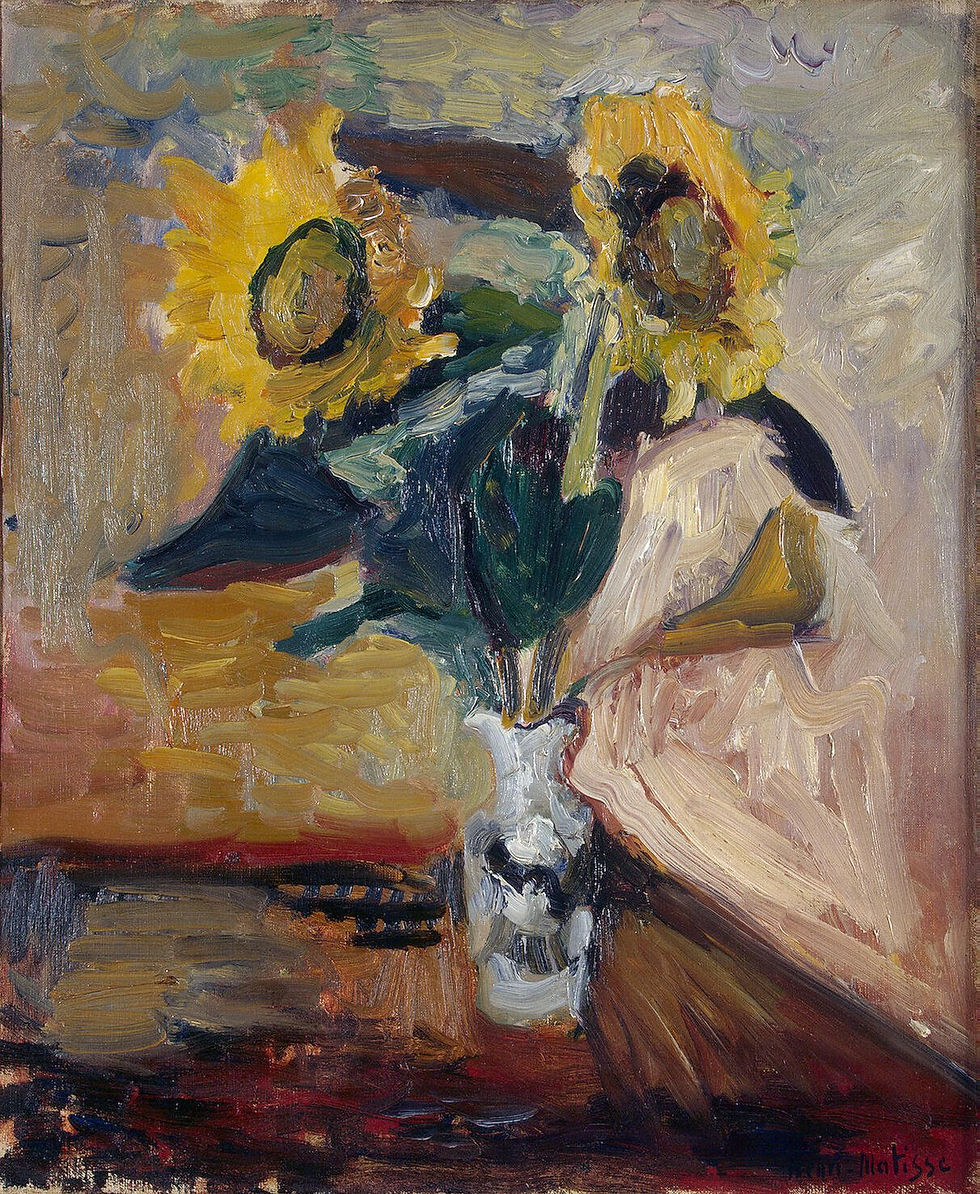
One other notable layer that strengthens my appreciation for sunflowers is that, in 2016, the sunflower was introduced at London’s Gatwick Airport as a subtle, dignified marker
that someone is living with an invisible disability. Since then, the sunflower has become a globally-recognized symbol to signal that a little more sensitivity or support might be helpful. Perhaps my favorite part is that it relies entirely on self-identification, so anyone who considers themselves to live with different abilities and related needs, diagnosed or not, is welcome to wear it, no paperwork or permission required.
I adore that a flower so famous for its visibility has become an emblem for what cannot so simply be seen, and that it honors each person’s right to decide when and how much to disclose. It also extends an invitation to the rest of us to move through the world with deeper compassion and greater patience, reminding us that each person may be carrying more than we can see or know.
Anything that helps us work harmoniously to co-create a culture of collective care and compassion is something I am very here for. (You also know you have hit a particular level of legitimacy when LEGO makes a minifigure for you.)
Light Work
If you have made it this far, whew, I appreciate you digging this deep alongside me! I hope some of what has jazzed me along the way sparks something for you, too!
tl;dr: sunflowers convert light into energy. Much of my work asks how people do the same. I consider myself a lightworker in that fairly practical sense: I pay attention to what gives people energy, and I help them identify it, feel it, explore it, trust it, and orient their lives toward allowing more of it in. Sometimes the light is joy, purpose, pleasure, or love, other times anger, grief, desire, or the sudden recognition that something can no longer continue as it has. Light does not always feel pleasant; it reveals, and that revelation is often accompanied by shadows as well. Still, what we turn toward, we grow toward, and as surely as the sunflower turns to meet each dawn, I have a knack for finding and turning toward the light.
With all of these layers in view, imagine my delight that people have come to associate me with these magnificent plants, sending them my way when they are encountered in the wild and affirming the similarities they see between the flower and how I show up in their lives and in the world.
I do not speak in absolutes very frequently, yet I can safely say it is never not uplifting and sweet to receive a sunflower salutation that has been sent my way.
So, if a sunflower finds its way to you from me, it is a demonstration of intentionally employing this ethos in action and an invitation for you to carry a little sunflower medicine into whatever comes your way, too.
A little bit of me, and also a mirror for you. 🌻